Europe Riot: Security Challenges and Solutions Amid Gen Z Protests

European cities are confronting a new wave of unrest driven by rising living costs, strained public services and housing pressures. Demonstrations in France, Spain, Italy, Belgium and Albania have drawn hundreds of thousands of participants. While many marches remain peaceful, breakaway groups have engaged in looting, arson and clashes with police, creating acute challenges for security professionals tasked with protecting people and property.
Scale of the Unrest and Immediate Threats
French authorities estimated 410,000 participants nationwide on the latest Saturday, with unions claiming roughly double that figure. In Paris alone, police put the turnout at 110,000. Laurent Nuñez, France’s Interior Minister, reported nearly 1,000 arrests that day, a figure later updated to 1,314, along with 53 injured officers. He noted that “in almost every march we saw the formation of these high-risk groups. They broke away from the main body and sought to commit acts of violence.” Similar patterns appeared in Barcelona, where roughly 100 people were detained—about a quarter of them minors—after shops were looted and street furniture set alight. In Milan, earlier weekend violence prompted the deployment of an additional 500 soldiers.
These incidents highlight the dual threat: large, mostly orderly crowds that can mask smaller, organized elements intent on opportunistic crime or confrontation. Retail districts, luxury stores and public infrastructure become high-value targets once dispersal begins and visibility drops. Security professionals face the difficulty of distinguishing legitimate protesters from those exploiting the cover of a demonstration. Rapid escalation after nightfall has repeatedly overwhelmed initial police lines, as seen when hooded groups in Paris and Marseille targeted vehicles and storefronts.
Protecting Commercial Assets and Public Spaces
Business groups reported that thousands of shops and other premises suffered damage or looting during the previous weekend, with losses estimated in the hundreds of millions of euros. In response, many retailers in central Paris and Milan boarded windows in advance, while others hired private security. Paris police later stated that “the security measures put in place were specifically designed to provide maximum protection for shops.” This approach—pre-positioning barriers, increasing static guards at high-risk retail clusters and coordinating with local chambers of commerce—reduced the scale of theft compared with the prior weekend, even as some incidents still occurred.
Security firms operating in affected cities emphasize layered measures: temporary physical hardening of storefronts, CCTV monitoring linked to rapid-response teams, and pre-agreed protocols with police for when to lock down premises. For larger commercial zones, the presence of uniformed private guards can deter opportunistic looting while allowing public forces to concentrate on active violence. Clear communication channels between private operators and municipal authorities remain essential so that guards do not inadvertently escalate situations or leave gaps that criminals exploit.
Public-Order Tactics and Resource Allocation
France mobilized approximately 70,000 police officers and gendarmes—10,000 more than the previous weekend—supported by armoured vehicles, water cannons, helicopters and drones. Laurent Nuñez declared, “We will be uncompromising with rioters, looters and all who commit violence.” Elite units normally reserved for counter-terrorism were placed on standby. Italy’s government under Giorgia Meloni supplemented police with military personnel in Milan and introduced tighter penalties for violent participation in demonstrations. Partial curfews and restrictions on certain routes further limited the mobility of disruptive groups.
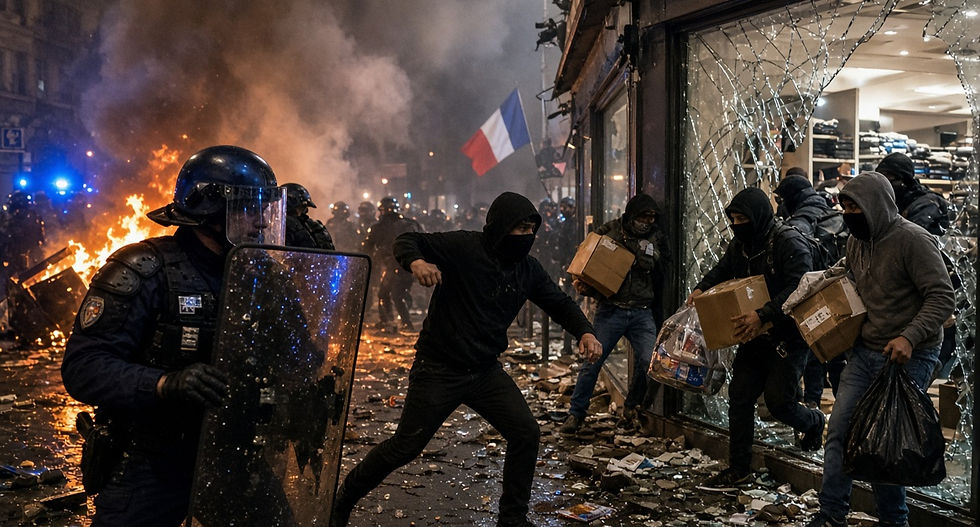
These deployments reflect a deliberate shift toward saturation coverage of known flashpoints. By saturating high-risk areas early, authorities aim to prevent the formation of the breakaway groups Nuñez identified. Challenges remain, however: sustaining such numbers over successive weekends strains personnel and logistics, and the presence of large police contingents can itself become a focal point for confrontation. Professionals note that intelligence on planned routes and social-media calls for violence is critical for positioning assets before marches begin, rather than reacting once disorder is already underway.
Longer-Term Measures for People and Property
Beyond immediate event security, professionals stress the value of ongoing risk assessments for businesses and residents in urban centres that have experienced repeated unrest. Practical steps include reviewing insurance coverage for civil-disturbance damage, installing reinforced shutters or security film on windows, and establishing internal protocols for staff evacuation and asset lockdown. For residential areas near protest routes, temporary increases in patrols or community watch coordination can reduce secondary incidents such as vehicle damage or opportunistic burglary while attention is focused elsewhere.
Coordination between public and private security remains a key gap in several cities. Where private guards are integrated into overall plans—sharing real-time observations without assuming law-enforcement powers—response times improve and collateral damage declines. Training that emphasizes de-escalation alongside physical protection helps guards manage both the protection of clients and the avoidance of unnecessary friction with demonstrators. As further actions are already scheduled in multiple countries, the ability to adapt these layered measures quickly will determine how effectively people and property can be safeguarded while the right to peaceful assembly is preserved.