
San Francisco festival deployment puts AI weapons screening claims to the test
 By Paula Vettori · Feb 5, 2026 · 3 min read
At San Francisco’s free Stern Grove Festival, Evolv Technology’s installation of its Express scanners is being pitched as a way to speed entry without weakening screening, a summer-season trigger that matters to the people who buy and operate weapon detection systems because crowd volume, bags and picnic gear create the worst-case mix for false alerts and missed knives.
Why this deployment matters now
Free, open-air festivals concentrate risk: variable ingress points, patrons carrying metal cutlery, cans and chairs, and a hard deadline when the headliner starts. A deployment that works here has meaningful signal for stadiums and arenas heading into fall schedules. Operators aren’t evaluating a glossy demo; they’re asking whether knife sensitivity can hold at peak flow without turning secondary screening into the bottleneck the front gate claimed to remove.
What the company says
“We are proud to partner with Stern Grove Festival, supporting their mission to offer safer, more enjoyable events,” said John Kedzierski, CEO and President of Evolv Technology. “Evolv Express is a strong fit for venues like Stern Grove Festival, where visitor safety and experience are both key considerations.” Evolv Technology develops AI-enabled weapons detection gateways for high-traffic environments such as stadiums, schools and public spaces, which is directly relevant here because Express units must maintain knife sensitivity at speed while contending with metal-heavy picnic items that can spike nuisance alarms.
The real tradeoff operators own
Turn the sensitivity up and you’ll catch more small, partially metallic blades — and also more aluminum forks, chair hinges and cookware. Turn it down and you’ll protect throughput but accept higher miss risk. The right answer isn’t universal; it’s a posted, measurable target tied to your venue’s tolerance for adjudication delay and your insurer’s appetite for residual risk. If your plan doesn’t specify a knife sensitivity band, a maximum alert rate per lane, and a time-to-resolution SLA, you’re not running a program — you’re running a hope.
Design the lane for the patrons you actually have
Festival patrons arrive in waves with bags and coolers, not briefcases. That means stanchion geometry, bag-divert lanes and visible “allowed/leave-out” signage matter as much as sensor physics. A clean divert for picnic knives and bottle openers reduces front-end noise and lowers the temperature at secondary. If you don’t give people a place to self-correct before the portal, they will hand you a backlog after it.
Integrations make or break speed
No gateway operates alone. Radios must push clear, unambiguous adjudication codes. VMS should surface the right clip at the moment of decision. Ticketing needs a simple exception path for patrons diverted to secondary so supervisors can keep counts accurate. Analytics that no one reads between shows won’t save you. The test is whether your team can detect, decide and document under peak pressure with minimal cross-chatter.
Acceptance testing that actually predicts season performance
Treat the opening run as a live acceptance test. Set explicit knife test objects and carry modes. Run red-team drills during sound checks, not on a quiet Thursday morning. Log alert rate per thousand patrons, median and 95th-percentile adjudication time, and the percentage of alerts resolved by patron self-disposal versus secondary inspection. Track firmware stability and spare-unit swaps; a lane that drops at pre-show crush is a payroll problem by another name.
Procurement guardrails before you scale
If this summer proves out, expansion will be tempting — and that’s where path dependence creeps in. Once your post orders, signage and training are written to one vendor’s alert language, switching costs climb. Bake in performance-based payments tied to knife detection efficacy and adjudication SLAs, require periodic third-party red-teaming, and preserve data-export rights so you’re not stuck inside a dashboard that can’t answer an investigator’s question after an incident.
This deployment is a useful trial by fire. If knife sensitivity holds at target while lines move, and if adjudication stays disciplined with acceptable secondary load, operators gain a blueprint for high-throughput screening that doesn’t wreck the show. If not, the bottleneck hasn’t been solved — it’s just moved down the line.

Gunshot Sensors Confirm Blast and Flash at the Edge. Alerts Skip the Human Queue
Sep 22, 2026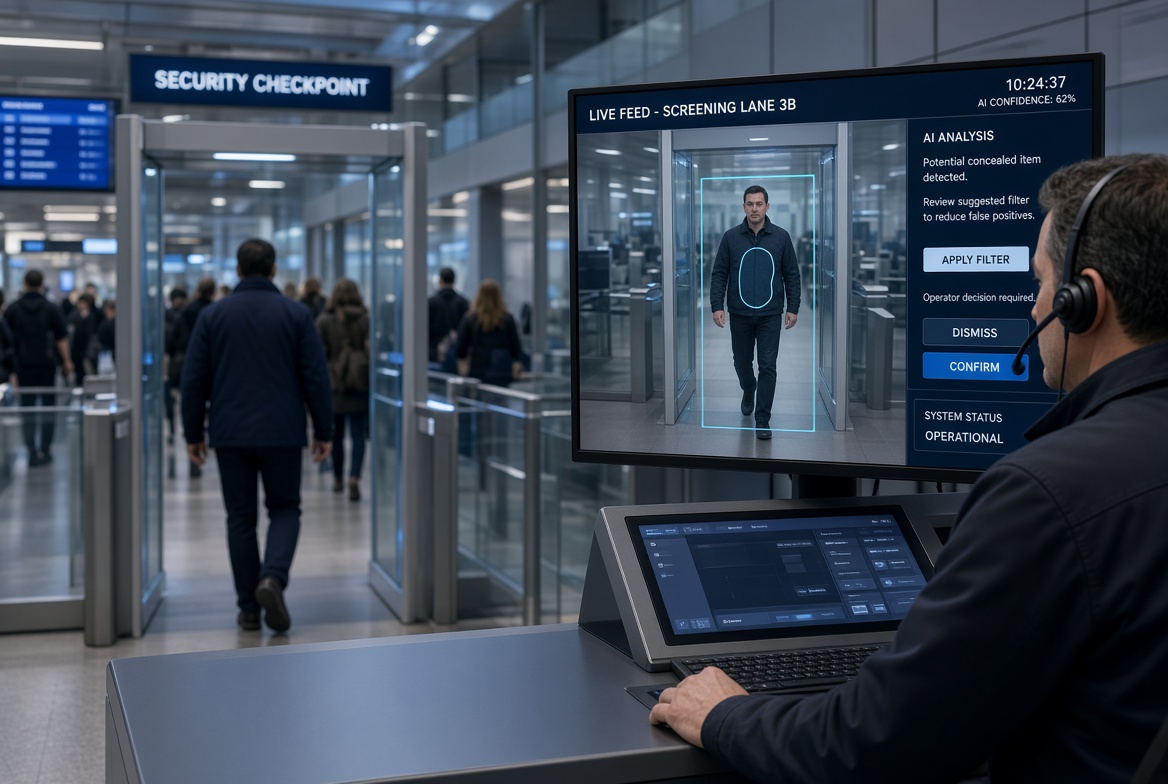
"Screening Narrows the Hits. Humans Still Decide Who Gets Stopped"
Sep 22, 2026