
AI Video Monitoring Moves From Detection to Contextual Reasoning in Enterprise Security Operations
 By Paul Epstein · Jul 1, 2026 · 5 min read
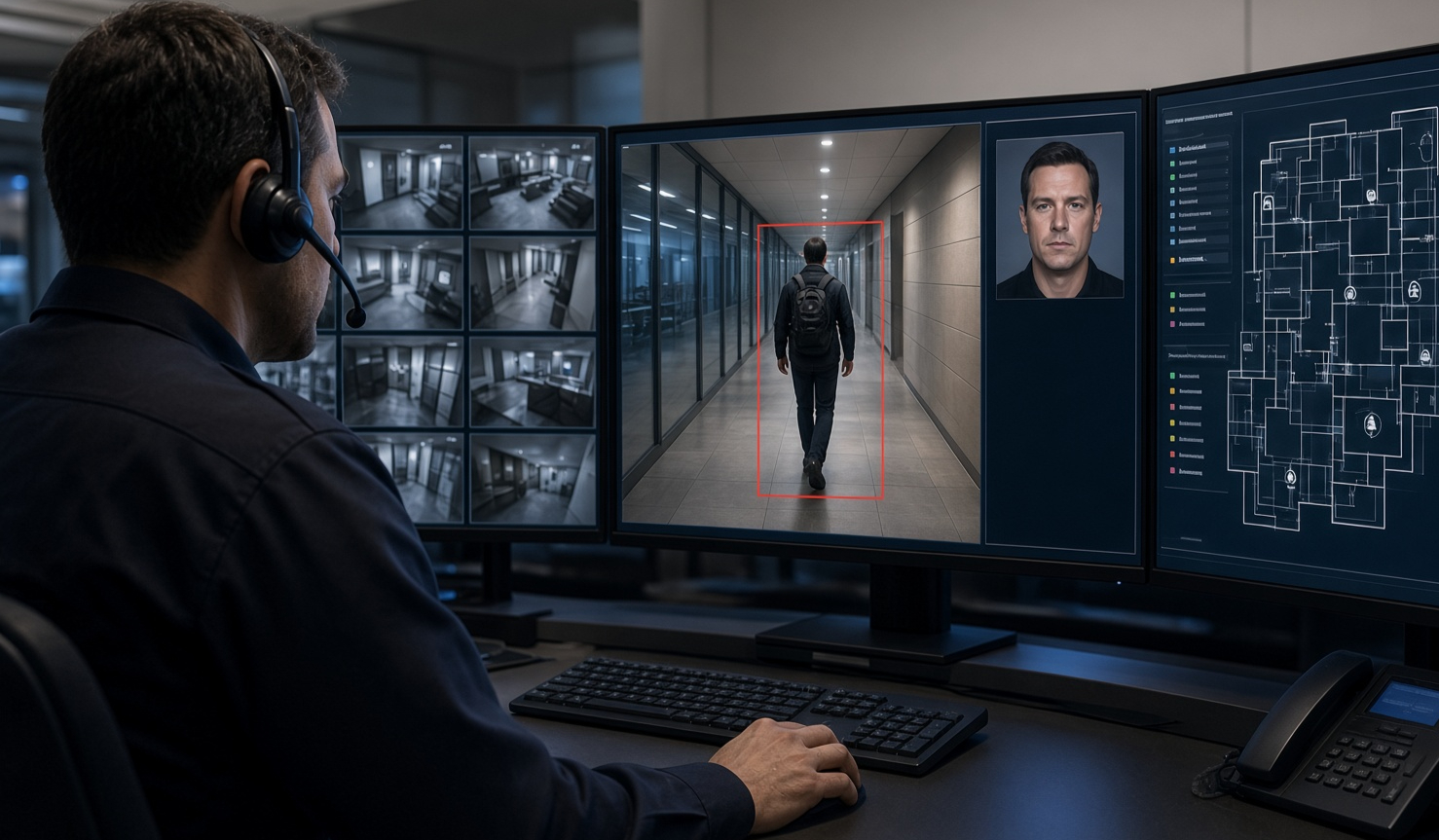
As enterprise security teams expand camera coverage across corporate campuses, healthcare facilities, schools, and critical infrastructure sites, the operational challenge is no longer raw detection. Motion flags, object recognition, and rule-based tripwires have been available for years. The constraint is signal quality. Excessive false positives, ambiguous alerts, and fragmented system handoffs continue to burden control rooms, inflate response costs, and erode operator trust in automated systems.
Vikesh Khanna, CTO and Co-founder of Ambient.ai, provided written responses outlining how newer AI-driven architectures attempt to address this gap by shifting from frame-level detection to contextual reasoning and structured response orchestration.
From Motion Detection to Scene-Level Reasoning
According to Khanna, legacy video analytics systems rely primarily on motion thresholds, object classifiers, and static rules. These approaches detect movement or specific visual signatures but lack environmental understanding. “Detecting motion, objects, or even discrete events is insufficient,” he wrote. “The real distinction between normal activity and a security-relevant event requires scene-level reasoning.”
Ambient.ai’s approach uses a multi-stage model architecture.
At the edge, lightweight filtering models suppress environmental noise. These filters are designed to eliminate non-security artifacts such as lighting changes, weather-related movement, or routine foot traffic patterns before data is escalated to deeper analysis layers. The objective is early-stage noise reduction to limit unnecessary processing and reduce downstream alert volume.

At the core, deeper vision-language models trained on security-specific datasets perform contextual reasoning across time rather than evaluating single frames. These models assess behavioral dynamics, interactions, and deviations from environmental baselines.
Khanna offered an example: firearm detection alone does not determine threat. A reasoning model evaluates whether an individual appears to be uniformed law enforcement or an unknown subject, whether a weapon is holstered or actively brandished, how surrounding individuals react, and whether the activity deviates from typical environmental patterns. Temporal modeling and cross-scene correlation are used to distinguish sustained anomalous behavior from momentary irregularities.
This layered architecture combines edge filtering, domain-specific training, temporal context modeling, and vision-language reasoning. The intended outcome is reduced false escalation and lower operator fatigue by converting detections into security-relevant alerts rather than generic anomaly flags. The approach aligns with a broader industry shift toward behavior-based analytics. Vendors such as BriefCam, Milestone Systems, Genetec, and Avigilon have expanded analytics capabilities within VMS platforms, though architectural depth and reliance on rule-based versus reasoning-based models vary across the market.
Agentic Response and Structured Escalation
Detection quality alone does not resolve operational bottlenecks. Khanna emphasized that AI value materializes only when integrated into structured escalation workflows.
“Effective AI in physical security does not end at detection,” he wrote. “Its value is realized through structured, agentic response that operationalizes standard operating procedures in real time.”
He described the model as resting on three interlocking components. The first is verified threat assessment. High-confidence classification through reasoning models is designed to validate intent, severity, and environmental context before escalation occurs. Downstream systems are activated only when predefined risk thresholds are met, with the stated objective of reducing false dispatches and avoiding unnecessary activation of access control systems or emergency services.
The second component is automated workflow orchestration. Once an incident is verified, predefined playbooks trigger automatically. These can include locking specific access control zones, generating structured incident summaries, attaching relevant video evidence, notifying stakeholders through mass notification platforms, and preparing dispatch-ready briefs for field teams. The automation is intended to compress response latency while preserving operator oversight and final decision authority, with human validation remaining embedded in the process.
The third element is ecosystem interoperability. Enterprise security environments typically span access control systems, visitor management platforms, PSIM environments, emergency communication tools, and 911 dispatch interfaces. Khanna emphasized the importance of open architecture and API-level integrations to eliminate manual swivel-chair operations inside the control room. The objective, he wrote, is disciplined escalation rather than automation for its own sake. This interoperability requirement mirrors broader procurement trends, as enterprises increasingly demand open APIs and integration flexibility to avoid vendor lock-in and maintain compatibility with established platforms such as LenelS2, Honeywell, Johnson Controls, and others.
Measuring AI in Security Operations
A persistent industry issue is performance measurement. Traditional metrics often track activity rather than outcome. “The industry still relies on volume-based metrics: alarms acknowledged, patrols completed, reports filed,” Khanna wrote. “These measure busyness, not effectiveness.” Ambient.ai proposes a KPI and SLA framework oriented around outcome metrics across four categories.
GSOC and Control Room Efficiency
The primary metric is Alert-to-Response time. Ambient.ai benchmarks this at under two minutes at the 90th percentile, representing a stated 25 to 40 percent improvement over pre-AI baselines. Alarm Narrative Quality, measured through a QA rubric assessing incident documentation completeness, is targeted at 90 percent or above.
Case Wrap-Up Cycle Time, referring to post-incident paperwork burden, is expected to compress by 30 to 60 percent.
Pre-Arrival Brief Completeness measures whether field officers receive actionable intelligence before arrival on scene. For priority incidents, the target is 95 percent or higher.
Field Documentation Efficiency, defined as time saved per report through AI-assisted tools, is projected at a 30 to 50 percent reduction.
Governance and Human Oversight
Human Override Rate measures how frequently operators correct AI output. Ambient.ai states this should trend below 10 percent.
Khanna referenced research from Stanford and Microsoft indicating that in roughly 40 percent of real-world cases studied, AI action was complementary to, rather than a replacement for, human tasks. Maintaining this distribution is positioned as necessary to preserve accountability.
Service Level Agreements
For critical P1 incidents, the proposed AI-augmented standards include acknowledgment within 60 seconds, triage decision within two minutes, stakeholder communication within five minutes, and full report delivery within four hours.
Khanna contrasted these with traditional baselines of two to five minutes for acknowledgment and 12 to 24 hours for report completion.
He summarized the measurement shift as follows: “You cannot improve what you cannot measure, and measuring the wrong things optimizes for busyness, not safety.”
Operational Constraints and Governance Considerations
The deployment of behavior-based analytics in indoor commercial and enterprise environments operates within regulatory and governance constraints. In the outreach that prompted these responses, facial recognition was not positioned as the primary mechanism. Behavior-based models that analyze intent and interaction patterns may reduce exposure to biometric privacy regulations such as Illinois’ BIPA or EU GDPR provisions concerning biometric identifiers, though organizations remain responsible for lawful data handling, retention policies, and auditability.
Human-in-the-loop validation remains a structural safeguard against over-automation. Override metrics and role-alignment tracking are framed as governance controls rather than performance accelerators.
Market Implications
Enterprise security buyers are increasingly evaluating AI not on novelty but on operational reliability, integration depth, and measurable performance gains. False dispatch reduction, response time compression, documentation efficiency, and audit defensibility are becoming procurement criteria alongside detection accuracy.
Whether multi-stage reasoning architectures materially outperform rule-based analytics at scale will depend on sustained field performance and transparent measurement.
The structural shift underway suggests that the next competitive boundary in video security will not center on object recognition alone, but on contextual interpretation, workflow orchestration, and accountable automation inside the control room.