
Opinion: Is the Market Ready for Advanced Detection?
 By Marilyn Thaxton, North America Marketing Manager at CEIA USA · Jul 26, 2026 · 3 min read
Across schools, healthcare facilities, public venues, colleges & universities and more, security leaders are asking a similar question: not whether to strengthen screening, but how to do it without disrupting operations or public trust.
The market signals are clear. Demand for advanced detection technology is rising, yet procurement decisions are becoming more disciplined. Buyers are pressing vendors on measurable outcomes, screening optimization, total cost of ownership and operational fit, rather than simply adding visible checkpoints.
Procurement Is Becoming More Sophisticated
Security directors today are rarely making standalone purchases. Screening technology must integrate into layered security programs that include trained personnel, clear policies and coordinated response protocols.
Procurement teams are scrutinizing long-term cost structures, not just upfront pricing. Ambiguous subscription fees, software licensing, cloud storage and high maintenance costs can significantly alter a system’s real cost over three to five years. In budget-constrained environments such as public schools or municipal facilities, ease of use, transparent pricing, proven solutions, and predictable support models are becoming key decisive factors.
At the same time, certification and independent testing are no longer optional. Buyers expect documented compliance with established electromagnetic and electrical safety regulations, particularly as more people carry medical wearables and implants. In addition, built-in security levels and overall detection capabilities must align with recognized federal and international standards.
Mobility and Throughput Drive Adoption
Operational realities are also reshaping demand. Risk often clusters around high-density moments: morning arrival at schools, stadium entry before kickoff, theater lobbies before the curtain, museum entrances during peak visiting hours, congregation arrival at houses of worship before services, and patient check-in at healthcare center entrances.
In these environments, fixed, slow checkpoints can create bottlenecks that undermine both safety and experience. There’s a growing emphasis on versatility and high throughput, especially in crowd-heavy transitions.
Lightweight, rapidly deployable systems that can be repositioned as needed are gaining traction. Systems that screen individuals without requiring bag removal or complex operator input reduce staffing strain and keep lines moving. For heavy-traffic venues, throughput is not a convenience metric, it is a core operational requirement.
Balancing Effectiveness With Minimal Disruption
Organizations are also more sensitive to perception. Screening must be effective, but it cannot feel intrusive or obstructive. Privacy considerations now sit alongside detection performance in procurement discussions. Leaders want clarity around data logging, ownership and retention policies. Systems that avoid collecting unnecessary personal information and comply with privacy regulations are favored, especially in schools and civic spaces.
The broader goal is visible yet welcoming security. When screening is consistent, unbiased and predictable, it can reinforce trust rather than erode it.
Perhaps the clearest sign of market readiness is the growing focus on measurable operational results.
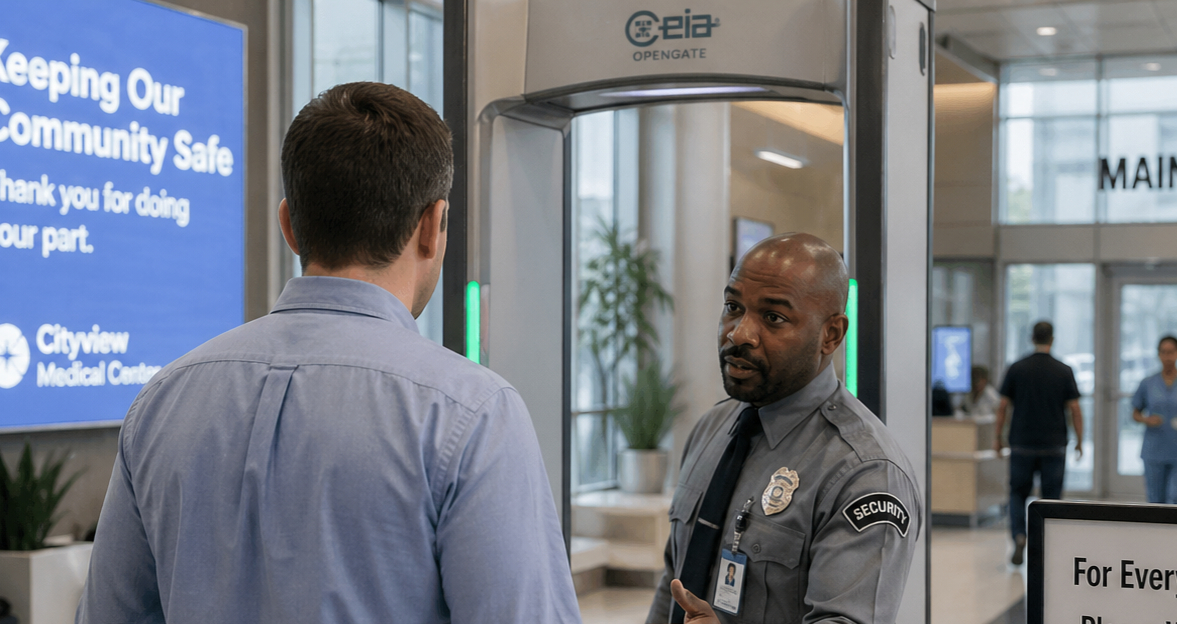
For example, the School District of Lee County, Florida reported a 39% decrease in school-related security incidents year-over-year following deployment of OPENGATE®, alongside declines reported by local law enforcement partners. While no single technology accounts for every improvement, documented reductions in incidents, arrests and citations demonstrate how detection can support broader safety strategies.
Similarly, public meeting environments such as school board sessions in large districts have incorporated mobile screening to manage crowd flow during emotionally charged gatherings. In these settings, flexibility and speed are as critical as detection accuracy.
Across sectors, several characteristics consistently rise to the top in procurement discussions: portability, ease of operation, compliance with recognized standards and predictable long-term costs. These characteristics align closely with what procurement teams now demand: solutions that are advanced yet simple, powerful yet unobtrusive.
Over the next 12 months, expect continued movement away from static, heavy, one-size-fits-all checkpoints toward adaptable deployments that match screening resources to real-world risk patterns. Total cost of ownership will remain under scrutiny. Privacy transparency will continue to shape purchasing criteria. And measurable outcomes will increasingly influence management and budget committees.
The market is ready for advanced detection technology. But readiness does not mean automatic adoption. It means security leaders are asking sharper questions about scalability, certification, staffing impact and public perception.
In this environment, the technologies that succeed will be those that support layered security strategies, respect operational realities and deliver results without creating new friction.
About the Author
Marilyn Thaxton is the North American marketing manager at CEIA USA, a global leader in advanced weapons detection systems. With more than 30 years of experience in the technology industry, Marilyn has become a thought leader in promoting technologies that enhance safety and security in critical environments, including schools, airports, and public venues. Her expertise includes aligning detection solutions with the unique needs of diverse organizations.
The opinions expressed in this article are those of Marilyn Thaxton. The Security Guys Insights are submitted content. The views expressed in this column are that of the author and don’t necessarily reflect the views of Security Guys News.