
Opinion: Hospital Weapon Detection Is No Longer a Pilot Program
 By Marilyn Thaxton, North America Marketing Manager at CEIA USA · Sep 3, 2026 · 4 min read
For years, hospitals talked about workplace violence in the abstract. Incident reports went up the chain, staff trainings were refreshed and signage was updated. But physical security at the front door often stayed the same.
That is changing fast.
Across the country, hospital security teams are being asked to solve a problem that can no longer be deferred or compartmentalized: how to prevent weapons from entering facilities that were never designed for controlled access.
This shift is not being driven by a single headline or a single law. It is coming from the accumulated weight of incidents, staff fatigue and rising liability exposure, and from the realization that traditional approaches are not enough.
The Security Problem Hospitals Can’t Isolate Anymore
Hospitals are fundamentally different from most environments security professionals protect.
They are open by necessity. They operate 24/7. They serve people under stress, pain or emotional distress. They manage unpredictable surges and life-or-death time pressure. And they often have dozens of public entry points that were designed for convenience, not control.
For security teams, this creates a constant tension: how to reduce risk without obstructing care.
Historically, many hospitals tried to localize the problem. Extra officers in the emergency department. Panic buttons in behavioral health. Cameras after the fact. But weapons don’t respect departmental boundaries. A knife or firearm brought in through a lobby does not stay contained to a single unit.
Security leaders are now being asked to think in terms of prevention at scale rather than response after impact.
Why Detection Is Moving Upstream
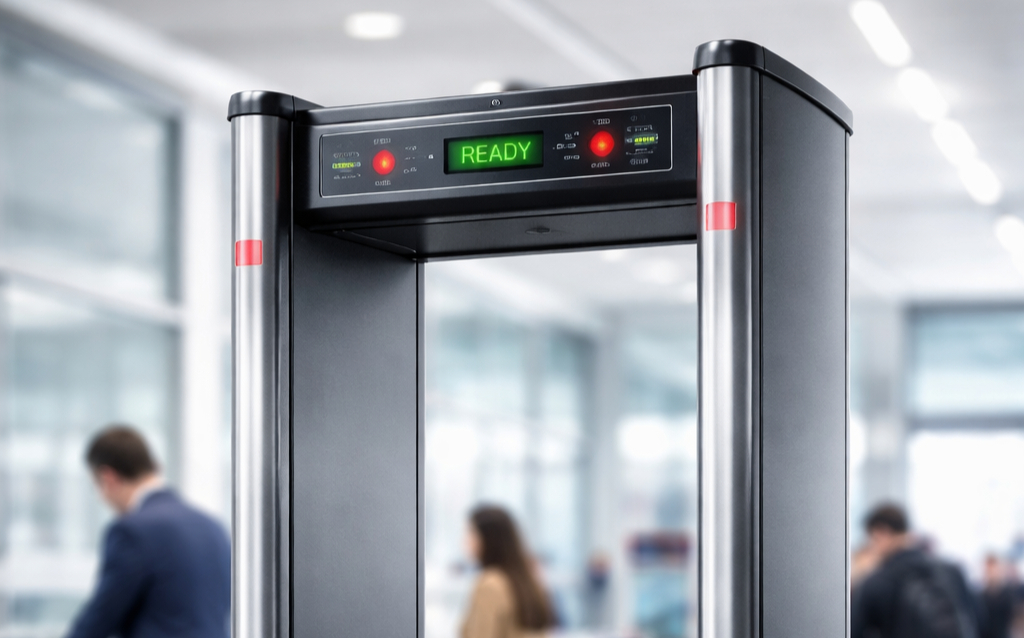
Weapon detection is no longer viewed as a last-resort response after a major incident. It is being evaluated as a front-end control - one that reduces downstream risk across the entire campus.
Several dynamics are driving this shift:
First, staff expectations have changed. Nurses, physicians and support staff are increasingly vocal about safety. Retention and recruitment are now tied directly to whether leadership is willing to implement visible, effective protections.
Second, liability conversations have matured. In the aftermath of violent incidents, questions are no longer limited to response time. They focus on what controls were in place to prevent weapons from entering in the first place.
Third, technology itself has changed. Many hospitals rejected screening because the operational burden outweighed the perceived benefit. That tradeoff is being reassessed because of the introduction of modern weapon detectors that focus on measurable standards, like OPENGATE.
Why Healthcare Screening Is an Operational Test, Not a Hardware Test
One of the biggest mistakes hospitals make is treating weapon detection as a procurement decision rather than an operational one.
The device matters, but the workflow matters more.
Security teams quickly discover that the real challenges are not about whether a system detects metal. They are about:
Where screening occurs without blocking clinical flow
Who staffs it and at what cost
How alerts are handled discreetly
What happens when someone refuses screening
How security maintains situational awareness while screening
Unlike venues built around checkpoints, hospitals rarely have controlled vestibules or fixed choke points. Screening must adapt to the building, not the other way around.
This is why many security leaders are moving away from rigid, screen-dependent systems and toward solutions that preserve officer awareness and flexibility.
Standards Are Becoming a Shortcut to Trust
As adoption increases, hospital buyers are becoming more disciplined.
Marketing claims are losing influence. Independent testing and standards are gaining.
Security directors want to know whether systems have been validated against recognized benchmarks, whether performance is repeatable and whether detection accuracy holds up in real-world conditions that include medical wearables, implants and high traffic.
For operators, standards offer something valuable: a common language for evaluating performance without relying on vendor promises.
Behavioral Health Was the Early Signal But Not the Endgame
Behavioral health units were among some of the first hospital environments to experiment with expanded screening. Risk is higher, acuity is elevated and the need for sensitive detection is clear.
What has changed is that behavioral health is no longer the boundary.
Hospital leadership is increasingly pushing for entrance-wide strategies that establish consistent expectations across campuses. The goal is not to stigmatize a department but to reduce overall exposure and remove ambiguity about what is allowed inside.
For security teams, this means planning beyond pilots and preparing for sustained operations.
What Security Leaders Are Actually Solving For
Conversations with hospital security professionals tend to converge on a similar set of priorities:
Detection that works without slowing care
Systems that are intuitive for officers with varying experience levels
Minimal training burden in high-turnover environments
Clear response protocols that avoid escalation
Technology that supports, not distracts from, human judgment
In short, hospitals are not looking for novelty. They are looking for reliability.
Screening as Infrastructure
The most successful hospital programs treat weapon detection the same way they treat fire suppression or access control: as infrastructure.
That means long-term thinking, operational ownership and integration into broader safety strategies. It also means accepting that prevention is not always visible - but its absence is.
For security professionals, healthcare offers a preview of where public-facing security is headed more broadly. Open environments, high emotion, complex risk and zero tolerance for disruption.
Weapon detection in hospitals is not about fear. It is about acknowledging reality and building systems that work within it.
The views and opinions expressed are those of Marilyn Thaxton, North America Marketing Manager at CEIA USA, and do not necessarily reflect the official policy or position of any affiliated organizations. Information is provided for general informational purposes only and should not be considered as professional advice.